
A professionally planned event can still fall short if the right people do not hear about it, understand its value, or feel enough urgency to attend.
For corporate conferences, leadership summits, product launches, exhibitions and employee events, promotion is not about reaching the largest possible audience. It is about reaching the right people with a relevant message, through channels they already trust.
That requires more than publishing an event poster or sending a single invitation email. A successful campaign connects the event goal, audience, speakers, landing page, promotional channels and attendee communication into one clear plan.
This guide explains how to promote an event from the first announcement to post-event follow-up, with practical advice for increasing both registrations and actual attendance.
TL;DR: How to Promote an Event Successfully
To promote a corporate event effectively:
- Define a measurable event goal.
- Identify the exact audience you want to attract.
- Create a clear reason for them to attend.
- Build consistent event branding and a focused landing page.
- Start promotion early enough for the audience and event type.
- Prioritise email, LinkedIn, speakers, partners and direct outreach.
- Add PR, influencers and paid media where they support the strategy.
- Use genuine deadlines, group offers and referrals to encourage registrations.
- Treat reminders as part of event promotion, not administration.
- Track registrations, attendance, leads, revenue and channel performance.
For most B2B events, email, LinkedIn, speaker amplification and partner distribution should lead the campaign. Paid advertising should support these channels, not replace them.
What Is Event Promotion?
Event promotion is the process of creating awareness, generating interest and encouraging the right people to register for and attend an event.
It forms part of a wider event marketing strategy.
For a corporate conference, promotion may involve LinkedIn, email, speakers, associations and direct invitations. A product launch may rely more heavily on PR, teaser content, demonstrations and industry influencers. An employee event may be promoted internally through managers, workplace communication and reminder campaigns.
The event format changes, but the principle does not: the message, channel and timing must match the audience.
Start With the Event Goal
One of the most common mistakes in event marketing is selecting promotional channels before deciding what the event is expected to achieve.
An organiser may decide to advertise on Instagram simply because the platform is popular. Another may start running paid ads without knowing how many registrations, leads or sales the campaign must generate.
The event goal should guide the campaign.
A conference might aim to attract 300 qualified attendees and generate 40 post-event meetings. A product launch may focus on media coverage, distributor participation and demonstration requests. An employee programme may be judged through participation, feedback and engagement rather than sales.
A useful objective should answer three questions:
- What action should the audience take?
- How many people should take it?
- What business or engagement result should follow?
“Generate awareness” is not specific enough.
“Generate 300 registrations from HR and business leaders in Delhi NCR, achieve at least 70% attendance and book 25 consultations” gives the campaign a clear direction.
Define the Audience Precisely
“Business professionals” is not a useful audience definition.
For a leadership summit, the intended audience may be founders, HR directors, department heads and senior managers from companies with more than 100 employees. For a product launch, the audience may include distributors, customers, journalists, creators and industry analysts.
This level of clarity influences:
- Which speakers you invite
- Which benefits you promote
- Which platforms you use
- How formal the invitation should be
- Whether attendees need internal approval
- How early the campaign should begin
A senior executive may need several weeks to reserve a date or approve travel. In some cases, an executive assistant may complete the registration, so the confirmation email should make it easy to forward the calendar invitation, agenda and venue details.
Understanding these practical details helps the campaign feel organised from the beginning.
Create a Strong Event Value Proposition
People do not attend a corporate event simply because a venue has been booked or a well-designed invitation has been created.
They attend because they expect to gain something valuable.
That value may come from practical knowledge, professional connections, access to an expert, a first look at a product, employee recognition or a solution to an industry problem.
A weak message says:
Join us for an exciting marketing conference with experienced speakers.
A stronger message says:
Learn how marketing teams are using AI, search, paid media and automation to reduce acquisition costs, with practical sessions led by specialists working directly in these areas.
The second version explains what attendees will learn and why the event is relevant.
Speaker quality matters more than speaker quantity. One highly relevant expert with a trusted audience may attract better attendees than several general speakers with little connection to the event topic.
Build Consistent Event Branding
The event name, visual identity and message should feel consistent across the landing page, emails, social media, speaker graphics, invitations, signage and presentation screens.
The style should also fit the event.
A leadership summit may require a polished and authoritative identity. A sports meet should feel energetic and inclusive. A technology launch may use a sharper, more modern visual style.
Consistency matters more than complexity. Someone who sees the event on LinkedIn and later receives an email should immediately recognise that both belong to the same campaign.
Build a Landing Page That Converts Interest Into Registrations
Your landing page is where event promotion either converts or fails.
It should answer the questions an attendee is likely to ask:
- What is the event about?
- Who should attend?
- What will I gain?
- Who is speaking?
- When and where is it happening?
- What does the ticket include?
- Why should I register now?
The headline should communicate the attendee benefit rather than simply repeat the event name.
Speaker profiles should explain why each person is relevant. The agenda should highlight outcomes, not only session timings. Previous-event photographs, testimonials and sponsor logos can help reduce uncertainty.
Keep the registration form short. For most corporate events, name, work email, phone number, company and job title are sufficient at the first stage.
Before launching paid ads, test the form on mobile, verify the confirmation emails and confirm that registration sources are being recorded correctly.
Do not spend money driving traffic to a page that has not been tested.
The Pinnacle Event Promotion Framework
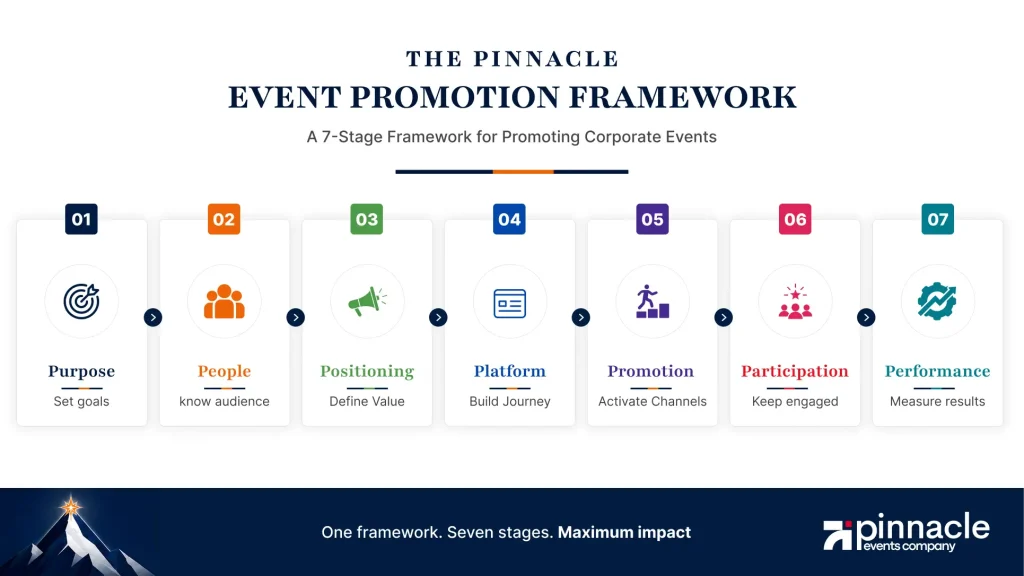
A practical event-promotion campaign can be organised into seven stages:
1. Purpose
Define the business or engagement objective.
2. People
Identify the exact attendees you need to reach.
3. Positioning
Clarify why the event deserves their time.
4. Platform
Prepare the landing page, registration process and tracking.
5. Promotion
Use the most relevant mix of owned, partner, earned and paid channels.
6. Participation
Keep registered attendees engaged until the event begins.
7. Performance
Measure attendance, leads, revenue and channel results.
This framework prevents organisers from rushing into promotion before the foundations are ready.
A 12-Week Event Promotion Timeline
The ideal timeline depends on the audience and the complexity of the attendance decision. A senior leadership event usually needs a longer lead time than a small internal programme because attendees may need approval, travel planning or calendar coordination.
10–12 Weeks Before: Prepare the Campaign
Finalise the event goal, audience, positioning, branding and core speakers. Build the landing page, configure analytics and prepare the first set of campaign assets.
Identify sponsors, associations and partners that can help with distribution. Give them enough time to include the event in their communication calendars.
Promotion can begin before every production detail is complete, but the date, format, value proposition and main event information should already be confirmed.
7–9 Weeks Before: Launch Registration
Introduce the event properly rather than publishing only a “save the date” graphic.
Explain the main attendee benefit, announce one or two strong speakers and open early-bird or group registration where appropriate.
Begin email and LinkedIn promotion, activate speakers and provide partners with ready-to-use content.
4–6 Weeks Before: Build Credibility
This is where many campaigns become repetitive.
Avoid sharing the same poster every few days. Publish speaker interviews, session previews, short educational videos, live Q&As, testimonials and behind-the-scenes progress.
Once the landing page has been tested, begin paid promotion and retargeting if they are part of the strategy.
2–3 Weeks Before: Create Urgency
At this stage, people need a reason to make a decision.
Highlight the strongest sessions, networking value, ticket deadlines, group packages and limited capacity. Ask speakers and sponsors to publish their second round of content.
For high-value corporate audiences, personal invitations and direct outreach can outperform broad social media posts.
Final Week: Focus on Attendance
The campaign objective now changes.
Registrations still matter, but the main priority is making sure confirmed attendees arrive.
Send calendar reminders, venue directions, parking information, reporting times, agenda updates and final speaker messages. For free events, ask attendees to confirm participation because the absence of a ticket fee often increases no-shows.
Use SMS or WhatsApp only where consent and appropriate communication permissions are in place.
Event Day and Post-Event
Share speaker insights, attendee reactions and live moments while the event is happening.
Afterwards, publish a recap, photo gallery, highlights and useful resources. Follow up with attendees, no-shows and qualified leads separately.
Which Channels Should You Prioritise?
Not every event needs every promotional channel. So when you are creating an even promotion strategy, make sure you are creating it as per your even type.
Corporate Conferences and Leadership Summits
Start with email, LinkedIn, speaker networks, industry associations and direct invitations.
The most important KPIs are qualified registrations, seniority of attendees, attendance rate and post-event leads.
For a 300-person leadership event in Delhi NCR, a practical campaign might combine email to previous attendees, speaker-led LinkedIn posts, association partnerships and personal invitations to selected companies.
Product Launches
Prioritise PR, teaser content, customer and distributor invitations, product demonstrations and relevant creators.
Measure media mentions, enquiries, demonstration requests, partner participation and product interest.
Employee Engagement Events
Use internal email, managers, leadership communication, office displays and approved workplace messaging groups.
The important outcomes are participation, employee sentiment, engagement and feedback.
Exhibitions and Trade Shows
Prioritise exhibitor networks, email campaigns, trade associations, industry publications, LinkedIn and direct buyer outreach.
Track qualified registrations, booth visits, meetings booked and business leads.
15 Strategies That Drive Registrations and Attendance
Use Email as a Campaign
Email remains one of the most reliable event-promotion channels because it allows direct communication with people who already know the organisation or have shown interest in the topic.
The mistake is treating email as a one-time announcement.
A useful sequence may include:
- Event launch
- Speaker Reveal emails
- Speaker or agenda highlight
- Educational content related to the theme
- Previous-event proof
- Ticket or group deadline
- Final registration reminder
The message should change throughout the campaign. Sending the same “register now” email repeatedly will lead to declining engagement.
Segment the audience where possible. Previous attendees, sponsors, customers, employees and senior prospects should not all receive identical communication.
After registration, move the person into an attendee sequence. They no longer need to be persuaded to register. They need a calendar invitation, agenda updates, practical information and reasons to stay committed.
Reminder communication is as important as the registration campaign.
Use LinkedIn as the Main Social Channel for B2B Events
For most conferences, leadership events and corporate programmes, LinkedIn should be one of the first channels in the promotion plan.
Organic social media rarely fills an event on its own, but LinkedIn supports professional credibility, speaker reach, employee advocacy and direct outreach.
The best-performing content is rarely a repeated event poster.
Use speaker insights, short videos, carousels, polls, industry observations, personal invitations and previous-event moments.
Posts from speakers, organisers and company leaders often feel more credible than posts from a brand page because they come from identifiable people.
Instagram can support events with strong visual content. YouTube is better suited to interviews, highlights and long-term discoverability. The platform mix should follow the audience rather than treating every social network equally.
Turn Speakers Into Promotion Partners
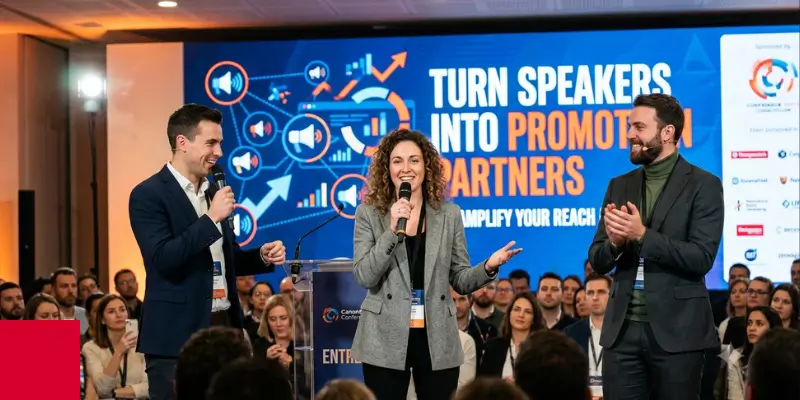
Speaker promotion is frequently left until the last minute.
Organisers add a speaker’s photograph to the event page and assume the speaker will generate interest independently. Busy experts rarely have the time to create a complete promotional campaign themselves.
Provide every speaker with:
- A personalised graphic
- A short LinkedIn post
- A video prompt
- A unique registration link
- Two or three agreed publishing dates
The promotion should extend beyond the announcement.
A speaker can participate in an interview, podcast, LinkedIn Live, short Q&A or session preview. With permission, share a key statistic, question or partial presentation slide to create curiosity.
A niche expert with a trusted audience can generate stronger registrations than a famous person whose followers are not relevant to the event.
Activate Sponsors, Associations and Partners
Sponsors should contribute more than a logo.
Their customer base, employee network and industry relationships may be more valuable than the branding placement itself.
Give partners an easy-to-use promotion kit containing email copy, social posts, graphics, tracked links and recommended publishing dates.
Industry associations and professional communities can be particularly useful because their audiences are already connected to the event topic.
A smaller but highly relevant network often performs better than a large general audience.
You can ask your partner that they can create a blog post on their website that they are proudly sponsoring the event and share the news on their social channels and shoot out a newsletter to their subscribers.
Collaborate With Relevant Influencers and Creators
A large follower count does not guarantee ticket sales or qualified attendees.
For business events, niche consultants, educators, podcasters, newsletter writers and community leaders may deliver better results than broad lifestyle creators.
Choose partners based on audience relevance, credibility and evidence of genuine engagement.
Complimentary passes should be linked to a clear deliverable, such as an interview, event preview, giveaway, live session or recap. Free tickets without an agreed content commitment rarely produce meaningful results.
Use unique links or codes so the partnership can be evaluated properly.
Use Podcasts and Expert Interviews
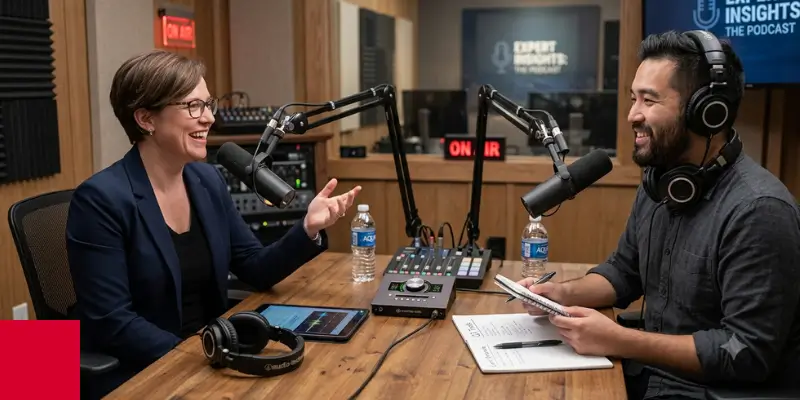
A single interview can create content for several weeks.
Invite a speaker or industry expert to discuss a genuine problem connected to the event theme. The conversation should be useful in its own right rather than functioning as a long advertisement.
The recording can become a podcast episode, short video clips, LinkedIn posts, email content, quote graphics and blog material.
This allows potential attendees to experience the speaker’s expertise before deciding to register.
You can create short reels from the episode and collaborate with the speaker. It will help you to reach to a broader audience.
Use PR When the Event Has a Real Story
A generic press release is rarely enough to generate media coverage.
The event needs an angle that matters beyond the organiser.
That may be new research, an important industry issue, a significant product launch, a respected expert, a social-impact initiative or a first-of-its-kind format.
A journalist covering a product launch will care more about what the product changes than the fact that an event is taking place.
Prepare a concise media brief, strong images, speaker details and interview opportunities. Personalised outreach to relevant publications is more effective than distributing the same release to a broad list.
Build Genuine Urgency
Deadlines and limited availability can encourage registrations, but artificial urgency weakens trust.
Use real incentives such as:
- Early-bird pricing
- Group packages
- Limited workshop seats
- VIP access
- Complimentary resources
- Corporate bundles
Avoid repeatedly extending an offer that was supposed to end.
Discounting tickets too early can also lower perceived value. A group benefit, bonus session or upgrade may be more effective than another reduction in price.
Encourage Referrals
Existing attendees, employees, speakers and partners can extend the campaign when there is a clear reason to participate.
A referral programme might offer ticket credit, group discounts, VIP access, merchandise or future-event benefits.
The reward should fit the audience. Senior attendees may value a networking upgrade more than a small promotional gift.
Keep the referral process simple and track every source.
Run Relevant Contests
Ticket giveaways can create attention, but they may also attract people who have little interest in the actual event.
Use an entry method that helps qualify participants.
Ask them to submit a question for a speaker, describe an industry challenge or nominate a colleague who would benefit from attending.
This produces better audience insights than a generic “tag three friends” competition.
Show Meaningful Behind-the-Scenes Content
Behind-the-scenes content can build anticipation when it shows real progress.
Useful moments include venue development, speaker rehearsals, welcome-kit preparation, branding installation, production testing and team coordination.
Not every preparation meeting needs to become a post. Repeated photographs of empty venues or laptop screens quickly lose value.
Choose content that adds excitement, credibility or useful attendee information.
Combine Online and Offline Promotion
Offline promotion still works when it matches the audience and location.
For corporate events in Delhi NCR, relevant options may include business associations, trade publications, office parks, partner locations, printed executive invitations and direct outreach.
An employee programme may use workplace displays and manager announcements. An exhibition may rely on exhibitor networks and printed invitations to priority buyers.
Every offline campaign should lead to a trackable action. Use unique QR codes, landing pages or registration-source fields.
Use Corporate Gifting With a Clear Purpose
Goodies should support the campaign or attendee experience rather than being added automatically.
They can reward early registration, welcome VIPs, encourage social sharing or create sponsor visibility.
For a leadership summit, a useful notebook, bottle or curated welcome kit may fit the audience. For an employee sports event, practical branded items may strengthen participation and team identity.
The gifting strategy should reinforce the event brand and objective.
Use Paid Media Selectively
Paid advertising should support a working campaign, not rescue unclear positioning or a weak landing page.
Google Search Ads can reach people actively looking for relevant conferences, training or solutions. LinkedIn can target job titles, industries and seniority, although the cost may be high. Meta is useful for visual promotion, local awareness and retargeting.
Retargeting is often the most efficient starting point because it focuses on people who already visited the landing page, viewed a video or started registering.
Track cost per registration, attendee quality and eventual business value. Impressions alone do not show whether the campaign worked.
Promote During and After the Event
Live content expands the reach of the current event and provides material for future campaigns.
Assign a dedicated content team to capture speaker quotes, audience reactions, short interviews, networking moments and sponsor activities. The operations team should not be expected to manage live content while also handling vendors, speakers and attendees.
After the event, publish a recap, photo gallery, highlights, speaker clips and testimonials.
Follow up with each audience separately:
- Attendees may receive resources and a survey.
- No-shows may receive selected highlights.
- Qualified leads may need a case study, consultation link or personal follow-up.
The event may last one day, but the content and commercial value should continue much longer.
Organic Event Promotion Channel Comparison
The following ratings are directional. Performance will depend on the event type, audience, campaign length and quality of execution.
A score of 1 indicates a relatively low requirement or potential. A score of 5 indicates a high requirement or strong potential.
| Promotion Channel | Time & Efforts | Potential | Expertise | Main KPIs |
|---|---|---|---|---|
| Email marketing | 3/5 | 5/5 | 3/5 | Clicks, registrations, attendance |
| LinkedIn organic | 4/5 | 5/5 for B2B | 3/5 | Reach, clicks, registrations |
| Speaker promotion | 3/5 | 5/5 | 2/5 | Referral traffic, registrations |
| Partner promotion | 3/5 | 4/5 | 3/5 | Partner clicks, lead quality |
| Event SEO and blogs | 5/5 | 4/5 long-term | 4/5 | Rankings, traffic, registrations |
| Influencer collaboration | 3/5 | 4/5 | 4/5 | Engagement, code usage, sales |
| PR | 4/5 | 4/5 | 5/5 | Mentions, links, referral traffic |
| Referral programme | 3/5 | 4/5 | 3/5 | Referral registrations |
| Offline partnerships | 4/5 | 4/5 | 3/5 | QR scans, enquiries, registrations |
| Post-event content | 5/5 | 5/5 long-term | 4/5 | Views, leads, future sign-ups |
Event Marketing KPIs That Matter
A long report filled with impressions can hide weak registrations and poor attendance.
Track metrics across four stages.
Awareness
Monitor reach, website visitors, video views, branded searches and media mentions.
These numbers show visibility, but not campaign success.
Conversion
Track registrations, ticket revenue, registration conversion rate, cost per registration, abandoned forms and registrations by channel.
Attendance
Measure check-ins, attendance rate, no-show rate, session participation and livestream viewers.
A registration is not the final outcome unless the person attends or completes the intended next step.
Business or Engagement Outcomes
For external events, track qualified leads, meetings, sales opportunities, revenue influenced and sponsor results.
For internal events, focus on participation, employee feedback, engagement and satisfaction.
Common Event Promotion Mistakes
Starting Too Late
A late campaign creates dependence on discounts, urgency and paid advertising.
Targeting an Audience That Is Too Broad
General messaging usually produces weak engagement and lower-quality registrations.
Repeating the Same Event Poster
Attendees need speaker value, educational content, proof and practical information—not the same graphic every few days.
Depending Only on Social Media
Corporate events usually need email, speakers, partners and direct outreach as well.
Ignoring Attendance Communication
Free events can collect impressive registration numbers and still have empty seats. Calendar invitations and reminders are essential.
Measuring Only Reach
High impressions do not guarantee qualified attendees, leads or revenue.
Frequently Asked Questions
What is the most effective way to promote a B2B event?
For most B2B events, email and LinkedIn should lead the campaign, supported by speakers, partners, associations and direct invitations. Paid advertising can expand reach once the landing page and tracking are working correctly.
How far in advance should you promote a corporate event?
A small event may need four to eight weeks. A conference, exhibition or leadership summit may require three months or more, particularly when attendees need approval, travel or calendar coordination.
How many promotional emails should you send?
Most campaigns need more than one announcement. A sequence of four to six useful emails spread across several weeks is generally more effective than frequent repetitive reminders.
How do you reduce no-shows?
Send calendar invitations, agenda updates, speaker previews, directions and final confirmation reminders. Free events usually require a stronger reminder strategy because attendees have made no financial commitment.
Should you use paid advertising?
Use paid ads when the audience can be targeted accurately and the event value justifies the cost. Retargeting is often a better starting point than broad awareness advertising.
How can you track offline event promotion?
Use unique QR codes, campaign landing pages, referral codes and registration-source fields to measure printed invitations, posters, partner locations and trade publications.
Should free and paid events use the same promotion strategy?
No. Paid events require stronger proof and perceived value before purchase. Free events generate registrations more easily but usually experience higher no-show rates.
Final Thoughts
Successful event promotion is not about appearing on every available platform.
It begins with understanding who should attend and giving them a clear reason to care. The campaign should then reach them through trusted channels, provide enough proof to support the decision and stay connected until the event begins.
For most corporate events, email, LinkedIn, speakers, partners and direct outreach should form the core of the strategy. PR, influencers, paid advertising, offline promotion and gifting should be added where they support the audience and objective.
The real measure of success is not the size of the registration list. It is whether the right people attend, engage and take the next step.